When a Weakened European Chemical Industry Met CBAM
How will chemical and raw material sourcing be impacted now that tighter EU environmental rules have been enforced?

As the new year began, so did new environmental laws. Most significantly for businesses across the EU was the introduction of the Carbon Border Adjustment Mechanism (CBAM)—a law designed to impose a fee on imported goods based on the greenhouse gases emitted during their production. It is legislation aimed at preventing carbon leakage and ensuring that imported products face similar carbon costs as those produced within the EU.
Theoretically, at least, this will promote cleaner industrial practices globally and a levelling of the playing field for EU manufacturers and chemical producers.
In practice, CBAM introduces a new layer of expense for imports of carbon-intensive feedstocks and has arrived at a time when Europe’s chemical industry is already under the severe pressure of shrinking capacity, weak demand, and structurally higher production costs than many global competitors.
For chemical traders and industrial buyers, the key question is how will CBAM interact with an industry already in decline and how will it impact the sourcing and pricing of industrial chemical products.
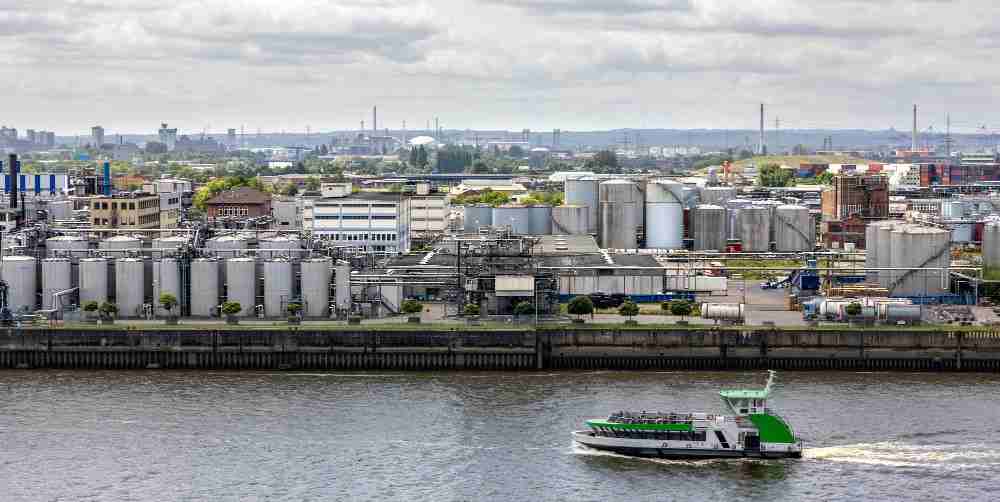
The European chemical sector has been struggling for decades, but the situation has deteriorated further in recent years, as high energy prices, inflationary pressure on labour and logistics, and subdued downstream demand have eroded margins across large parts of the raw material suppy chain.
The result is that many chemical producers are reducing operating rates, temporarily idling plants, or announcing permanent closures. According to chemical industry analysts at the Simon-Kucher consultancy, about 75% of energy-intensive companies in Germany are moving their investments overseas.
All while the global chemical market continues to expand. As a recent chemical industry report in C&EN notes, “[Europe’s] fundamental issue is that low-cost production capacity elsewhere in the world is growing.” Specifically adding that, “US exports of ethylene-based products more than tripled from 690,000 metric tons (t) worldwide in the first half of 2018 to 2.3 million t in the first half of 2025.”
This matters for European raw material traders because declining capacity does not automatically mean tighter markets. In many product groups, lower production has been matched — or even exceeded — by falling demand. The result is a fragile situation where prices are cut to the bone, inventories are tightly managed, and long-term planning becomes more difficult.
“Producing basic chemicals in Germany is becoming increasingly unattractive,” explains Jan Haemer, a partner Simon-Kucher. “Now the industry is migrating.”
This has led Europe to become increasingly reliant on imported raw materials and intermediates, as basic petrochemicals, fertiliser components, and energy-intensive upstream products. This has created a dependence on imports which CBAM hopes to correct.
What CBAM Changes for Chemical Trade
At its core, CBAM introduces a carbon cost on imports of selected high-emission products, linked to the EU Emissions Trading System. Importers are required to report embedded emissions and, over time, purchase CBAM certificates reflecting the carbon price.
While chemicals are not yet comprehensively covered, sectors such as fertilisers are, with further expansion into individual chemical products widely expected. Even before formal inclusion, CBAM created uncertainty across chemical supply chains as suppliers outside the EU were being asked to provide emissions data.
Related articles: 4 Warnings for Raw Material Sourcing in 2026 or EU-Australia Deal to Reshape Raw Material Supply
For raw material importers and traders, this means that CBAM is not just a regulatory issue but is also a cost-forecasting problem, with carbon exposure becoming another variable alongside freight rates, packaging costs, and currency risk. Chemical products that used to compete purely on price will soon compete on emissions intensity as well.
What This Means for Chemical Traders and Buyers
The combined effect of CBAM and EU industrial decline is pushing European chemical trading towards greater flexibility in three key areas:
1. Sourcing strategies will need to evolve as diversification of supply becomes more important, not only for price reasons but also for emissions profiles and reporting requirements. This means that transparency on carbon intensity may soon become a commercial advantage, not just a compliance obligation.
2. Contract structures are likely to change as buyers may prefer shorter contracts, index-linked pricing, or clauses that allow for carbon-related cost adjustments. Spot sourcing and digital marketplaces will likely gain a bigger appeal in this environment as they are able to offer faster access to alternative suppliers as traditional, less-environmental chemical suppliers become uneconomic.
3. Pricing dynamics will become more uneven as CBAM costs will not be passed on uniformly. For some chemical products and markets, suppliers will be able to add the full carbon cost to the price. In others, they will have to absorb part — or even all — of the cost to stay competitive.
A Structural Shift, Not a Temporary Disruption
CBAM is not a one-off regulatory event, but part of a broader shift towards carbon-priced trade. The problem for many chemical companies is that it comes at a time when Europe’s chemical industry is already structurally weakened.
For chemical traders and industrial buyers, the key is to look past the headlines and fearmongering over the death of European chemical production. Instead, they should focus on actionable strategies, such as maintaining a clear understanding of costs, diversifying sourcing, and ensuring CBAM compliance and chemical product adjustment. Those that adapt their trading models today will be better positioned to not only navigate CBAM’s expansion but will also be able to profit from the EU’s vision of sustainability and its influence over industrial chemical markets.
As Richard John Carter, an independent consultant to the chemical industry, concludes, “2026 will see a painful continuation of the pressure to review traditional business models and beliefs.” Those willing to change will reap the biggest gains.
Photo credit: Freepik, pvproductions, Freepik, & Freepik