Is Chemical Regulation About To Catch Up?
The chemical industry has been playing regulatory whack-a-mole for decades. A class-based approach could lower risk—but not without disruption.
Chemical regulation has a pacing problem – chemical safety and regulation protocols still assess substances one at a time.
It is a system known as ‘regrettable substitution’—as soon as one chemical product is removed from the market and a near-identical replacement (carrying comparable risks) appears soon after.

For industrial chemical traders and suppliers, this isn’t abstract. It shows up in constant reformulation requests, shifting supplier specs, and chemical products that seem compliant today but questionable tomorrow. Like playing a game where the rules keep changing.
What “Regulating By Class” Actually Means
But now a growing movement in the US is looking to overhaul the governmental approach to chemical product safety by proposing a class-based regulation system which offers a different logic. Instead of evaluating substances one by one, it groups them based on shared structure, function, and hazard profile.
The argument is straightforward: if chemicals behave similarly, assess them together.
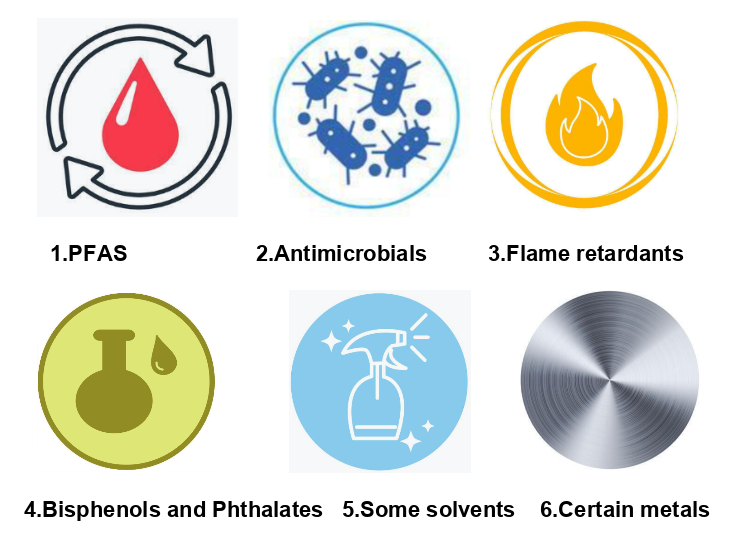
These have been defined by the Six Classes Organisation, which is spearheading the call for change, as follows:
- PFAS – A broad family of highly fluorinated compounds characterised by extreme persistence and mobility. Widely used in coatings, firefighting foams, and surfactants, but increasingly scrutinised due to bioaccumulation, long-range environmental transport, and mounting liability exposure across supply chains.
- Antimicrobials – Includes biocides, preservatives, and antibacterial agents used across plastics, textiles, and formulations. Regulatory concern centres on antimicrobial resistance, chronic toxicity, and diffuse end-use exposure, particularly where performance benefits are marginal.
- Flame retardants – Encompasses halogenated and organophosphate systems used in polymers, electronics, and construction materials. Many legacy chemistries have already faced restriction, with ongoing pressure driven by persistence, toxicity, and indoor exposure risks linked to material degradation.
- Bisphenols and Phthalates – Core additives in polycarbonates, epoxy resins, and plasticisers. Regulatory focus has shifted from individual substances (e.g., BPA) to broader endocrine-disrupting potential across structurally similar analogues, complicating substitution strategies.
- Some solvents – A loosely defined but commercially significant group, including chlorinated solvents and certain oxygenated compounds. Key issues include volatility, occupational exposure, and environmental persistence, with regulatory attention increasingly targeting functional use patterns rather than individual molecules.
- Certain metals – Typically refers to heavy metals and their compounds used in catalysts, pigments, stabilisers, and electronics. Concerns centre on toxicity, bioaccumulation, and recyclability constraints, particularly under tightening circular economy frameworks.
According to the project’s founders, it is an approach based less on banning everything in sight and more about filtering smarter so that decisions can be made earlier in the developmental, production, and organisational processes.
“Studying the tens of thousands of chemicals on the market today one at a time is just not feasible,” explains Arlene Blum, a chemist and executive director at the Green Science Policy Institute which is helping the movement. “But evaluating six groups of chemicals of concern is much more manageable.”
Class-based evaluation, the argument goes, reduces repetition of testing and legislation, speeds up decision-making, and cuts out entire categories of future risk before they enter the pipeline. It also tackles the core inefficiency of the current system—the endless loop of replacing one problematic chemical with another slightly tweaked version.
“The Six Classes framework is a screening and prevention tool that flags groups of chemicals with shared structures, mechanisms, and hazard patterns for early scrutiny,” says Rebecca Fuoco, GSPI’s director of science communications.
Others disagree on this approach. The American Chemistry Council (ACC), for example, believes that grouping chemically complex compounds together oversimplifies science and may jeopardise safety and innovation.
“Independent scientific bodies consistently find that chemicals grouped into a broad class do not share uniform hazard, exposure, or risk characteristics,” the ACC states. “Differentiating among substances or sub-categories within a class is essential for accurate scientific and regulatory evaluation.”
Any shift to class-based regulation also runs into a more structural reality: the chemical industry does not move quickly, and in many cases, it is not incentivised to. Existing regulatory frameworks are deeply embedded in national and regional legislation, backed by decades of toxicological data, and aligned with current chemical production assets.
A wholesale shift would create stranded investments and force rapid portfolio reassessment—something few large players will welcome. Add to that the influence of industry bodies such as the American Chemistry Council, which actively lobby for substance-by-substance evaluation, and progress becomes slower still.

Policymakers, meanwhile, are left attempting to balance environmental ambition with economic competitiveness, making sweeping reform politically difficult to push through.
For chemical industry professionals, a shift to class-based regulation would not be just a policy change—it would be an inflection point. A strategic policy change which promises fewer surprises and a more predictable compliance landscape. But one which also raises the stakes for chemical traders and suppliers who have product portfolios that sit within high-risk categories. Meanwhile, for manufacturers, the era of quietly swapping one molecule for another may be ending.
In its place may come a more structural rethink of what chemical products are worth trading in the first place.
To learn more about this topic read: From Compliance To Risk: Rethinking Chemical Regulation
Photo credit: Sixclasses, Vecteezy, Vecteezy, & Vecteezy